
This reflection on Matthew 25:31-46 was prepared by Kelly Meraw, Director of Pastoral Care and Liturgy, for the March “Evening for Women” program that was cancelled due to weather.
Jesus said to his disciples:
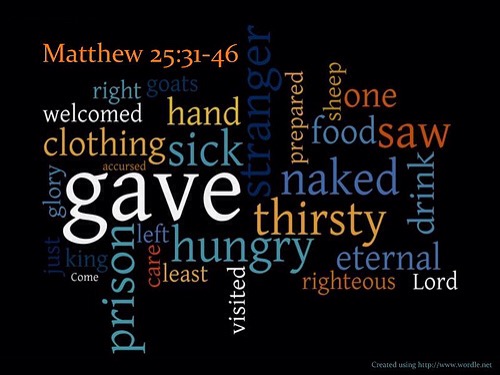
“When the Son of Man comes in his glory, and all the angels with him, he will sit upon his glorious throne, and all the nations will be assembled before him. And he will separate them one from another, as a shepherd separates the sheep from the goats. He will place the sheep on his right and the goats on his left. Then the king will say to those on his right, ‘Come, you who are blessed by my Father. Inherit the kingdom prepared for you from the foundation of the world. For I was hungry and you gave me food, I was thirsty and you gave me drink, a stranger and you welcomed me, naked and you clothed me, ill and you cared for me, in prison and you visited me.’
Then the righteous will answer him and say, ‘Lord, when did we see you hungry and feed you, or thirsty and give you drink? When did we see you a stranger and welcome you, or naked and clothe you? When did we see you ill or in prison, and visit you?’ And the king will say to them in reply, ‘Amen, I say to you, whatever you did for one of these least brothers of mine, you did for me.’
Then he will say to those on his left, ‘Depart from me, you accursed, into the eternal fire prepared for the Devil and his angels. For I was hungry and you gave me no food, I was thirsty and you gave me no drink, a stranger and you gave me no welcome, naked and you gave me no clothing, ill and in prison, and you did not care for me.’
Then they will answer and say, ‘Lord, when did we see you hungry or thirsty or a stranger or naked or ill or in prison, and not minister to your needs?’ He will answer them, ‘Amen, I say to you, what you did not do for one of these least ones, you did not do for me.’ And these will go off to eternal punishment, but the righteous to eternal life.”
This is the last of Matthew’s great parables. Every instinct I have (formed by my concept of a God of unfathomably deep love and infinite capacity for mercy) wants to skip the second half of this Gospel reading. On the majority of occasions when the great judgement, at the end of time, is proclaimed at Mass, the short form is selected, eliminating “the eternal fire, the Devil, and his angels” from tenderhearted ears. However, who is our God of Mercy without our God of Justice?
How could we survive a time such as this, with the worst of humanity before our eyes every day, if we didn’t also rest in the knowledge that Jesus is still present. Even if disguised and hidden, don’t we need to believe that God sees?
In so many ways this parable reminds us of God’s astonishing invitation to participate in the beloved community that gives. To be pioneers in God’s dream for us. To sustain the hope that by every small encounter we are truly able to coauthor an earth as it is in heaven. And in this parable Jesus tells us that God is waiting to give us everything if we accept the invitation.
We have a God of infinite opportunities. A God who bends time and space to love and form us. I can imagine the countless occasions Jesus, veiled and in the costume of “The Least”, appearing. Over and over. Never failing to invite through the face of the often ignored. Jesus, desiring engagement and participation. Mercy, new, every morning. Every time, only to be dismissed as unworthy in all sorts of dehumanizing iterations.
I can imagine the infinite number of times Jesus Himself has reached out to me and I’ve been too self-important to respond. And in those moments, I’ve made the decision to separate myself from God. To deny God the opportunity to be in communion with me. To close the door to my being a vehicle for Christ’s love in the world. And isn’t that the definition of eternal punishment? Separation from contribution in the holy work? Isn’t damnation the active choice to put a lifetime of distance between “creation” and “creator”?
In a time when civility has been overthrown, unrestrained greed is standard, racism is codified, the dignity of life is negotiable by circumstance, and the casualty of children’s innocence (and indeed their very lives) have become a price we are willing to pay for dominance – this Gospel reminds us that we will be judged uniquely on our treatment of those in need. We will be judged on our willingness to care for those who have no capacity to return our kindness.
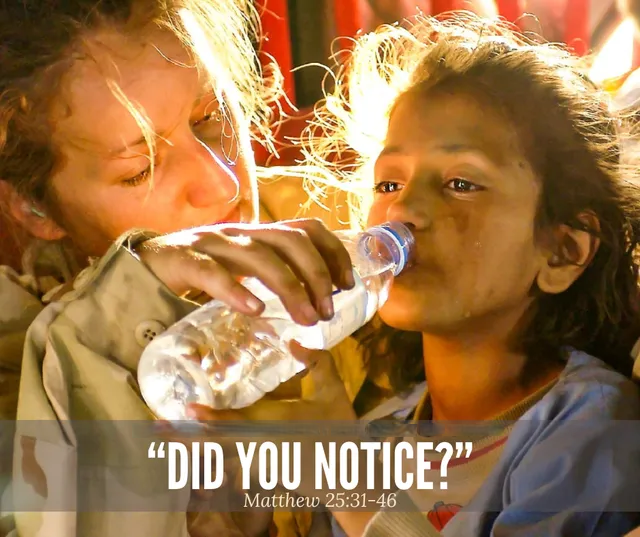
So this Lent, rather than fixing our eyes where they can too easily land on the vista of power, authority, wealth, and pride – may each of us who profess to follow Jesus accept Christ’s invitation and seek Him exclusively, as promised, in the hungry, thirsty, naked, sick, imprisoned, and stranger.
We will be judged because Jesus is still present. Hidden, but no less present. Hidden only to those who decide to deny that we each have infinite value to God.